
No net increase in ecosystem water limitation under greenhouse warming
Rebuilding the ecosystem water limitation framework based on net radiation, Yuanchao Fan's group at Tsinghua SIGS shows that widely used shortwave-radiation-based projections overestimate future water limitation on ecosystems.
Terrestrial evapotranspiration is jointly constrained by energy supply and water supply. Deciding whether a given landscape is short of energy or short of water is a foundational question for projecting ecosystem responses to climate warming. Since Denissen et al. (2022) introduced the ecosystem limitation index (ELI), studies in recent years have mostly followed their route: correlate soil-moisture anomalies and downwelling shortwave-radiation anomalies with evapotranspiration anomalies, and take the difference between the two as the limiting regime. The framework is elegant, but it equates energy supply with the shortwave radiation reaching the surface and assumes that more shortwave radiation promotes evapotranspiration. That assumption is the one worth re-examining.
A premise that violates Liebig's Law of the Minimum
Under Liebig's Law of the Minimum, a variable can serve as a limiting factor only if it satisfies two conditions at once: it is positively correlated with the response variable, and it places an upper bound on that variable. ERA5-Land reanalysis and FLUXNET eddy-covariance observations show that net radiation (Rn) sets a tight upper bound on latent heat flux at daily, monthly and annual timescales, whereas downwelling shortwave radiation (SWin) almost always exceeds the evapotranspiration rate and therefore provides little effective constraint. More tellingly, in most dry regions — and even in wet regions that should in theory be energy-limited, such as the fringes of the Amazon rainforest and the northern and eastern margins of the Congo Basin — shortwave anomalies correlate widely and negatively with evapotranspiration anomalies. A limiting factor should promote rather than suppress a process when its supply increases; these negative correlations therefore violate Liebig's Law of the Minimum outright.
Where the negative correlations come from: land–atmosphere coupling and double counting
These negative correlations are not energy limitation in the physical sense but a product of land–atmosphere coupling. Soil moisture, evapotranspiration, precipitation and cloud, shortwave radiation and soil moisture form a closed feedback loop: drier soils weaken evapotranspiration, cloud cover declines, and the shortwave radiation reaching the surface increases instead, so shortwave and evapotranspiration anomalies turn out negatively correlated. At the same time, shortwave radiation correlates positively with vapour pressure deficit (VPD), and near-surface air temperature covaries strongly with VPD; VPD itself represents atmospheric water demand and is the variable that drives water stress. Treating such variables as the “energy” indicator amounts to counting the water limitation already captured by cor(SM′, ET′) a second time — the same origin as the double-counting problem in drought indices noted by Swann et al. (2016). As a result, humid tropical regions (South Asia, Southeast Asia and parts of Amazonia) are systematically misclassified as water-limited.
The study therefore replaces the energy indicator with net radiation, yielding a net-radiation-based ecosystem limitation index (RELI): RELI = cor(SM′, X′) − cor(Rn′, X′), where X denotes evapotranspiration (ET) or transpiration (T); RELI > 0 indicates water limitation and RELI < 0 energy limitation. Net radiation integrates shortwave and longwave budgets and reflects land–atmosphere coupling including surface-temperature feedbacks, making it the thermodynamically appropriate energy constraint on turbulent fluxes. Shortwave radiation corresponds to photosynthetically available energy at the leaf scale, but cannot represent the surface energy partitioning and longwave feedbacks that control water and latent heat fluxes. The replacement rests on two arguments: the upper-bound and positive-correlation requirements of Liebig's Law, and the Budyko and thermodynamic treatments of turbulent exchange as constrained by available energy.
Result: no net increase, but bidirectional transitions
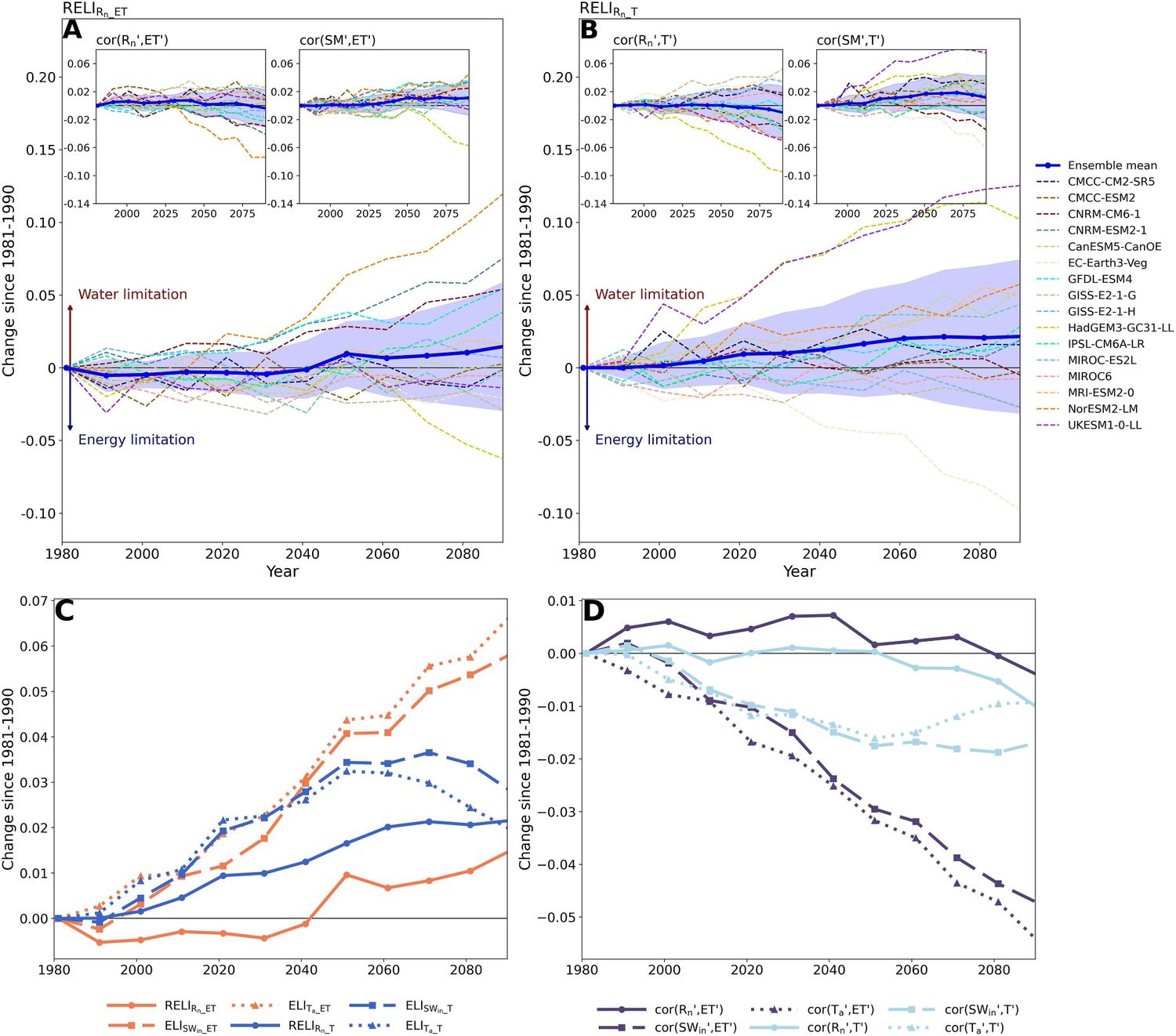
The study uses historical (1981–2014) and SSP5-8.5 (2015–2100) simulations from 16 CMIP6 models, regridded to 2° × 2°, with monthly anomalies detrended per decade and the seasonal cycle removed, retaining only land grid cells in the warm season (Ta ≥ 10 °C) with no fewer than 30 valid monthly values per decade. The results show that the ET-based RELI changes by only +0.015 ± 0.0453 (p > 0.05) by 2100, while the T-based RELI changes by +0.0216 ± 0.0534 (p > 0.05). Computed with shortwave radiation instead, the ELI rises by +0.0582 ± 0.0538 (p < 0.05), roughly four times as large. The rise in ELI does not come from stronger soil-moisture limitation — cor(SM′, ET′) increases only weakly — but from a systematic decline in cor(SWin′, ET′).
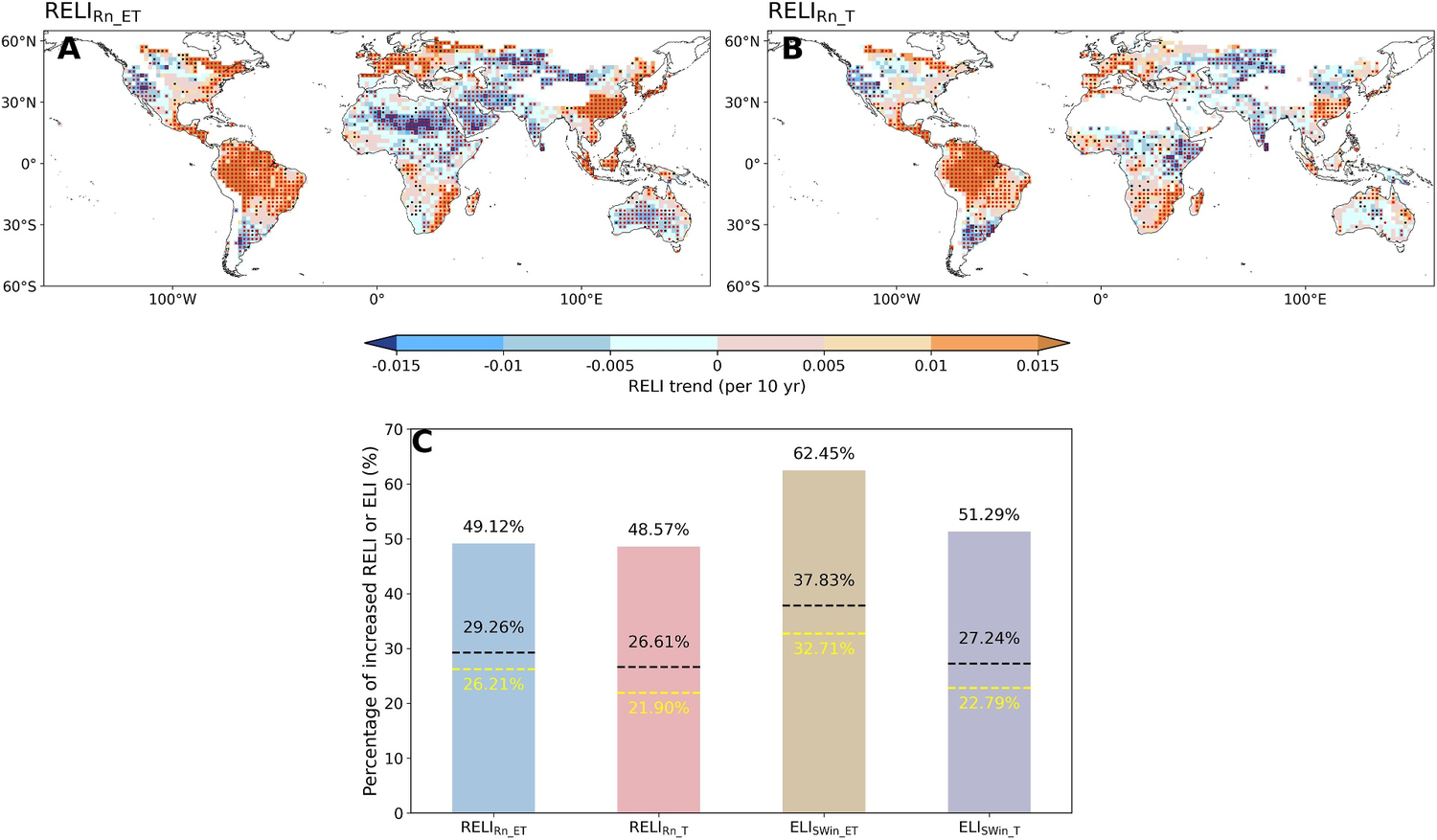
Spatially, warm land with a significantly increasing RELI trend (FDR-corrected) accounts for 26.21% of the area (ET-based RELI) and 21.90% (T-based RELI) over 1981–2100, versus 32.71% and 22.79% when downwelling shortwave radiation is used. Positive and negative RELI changes cover nearly equal areas, so no unidirectional shift from energy to water limitation appears at the global scale.
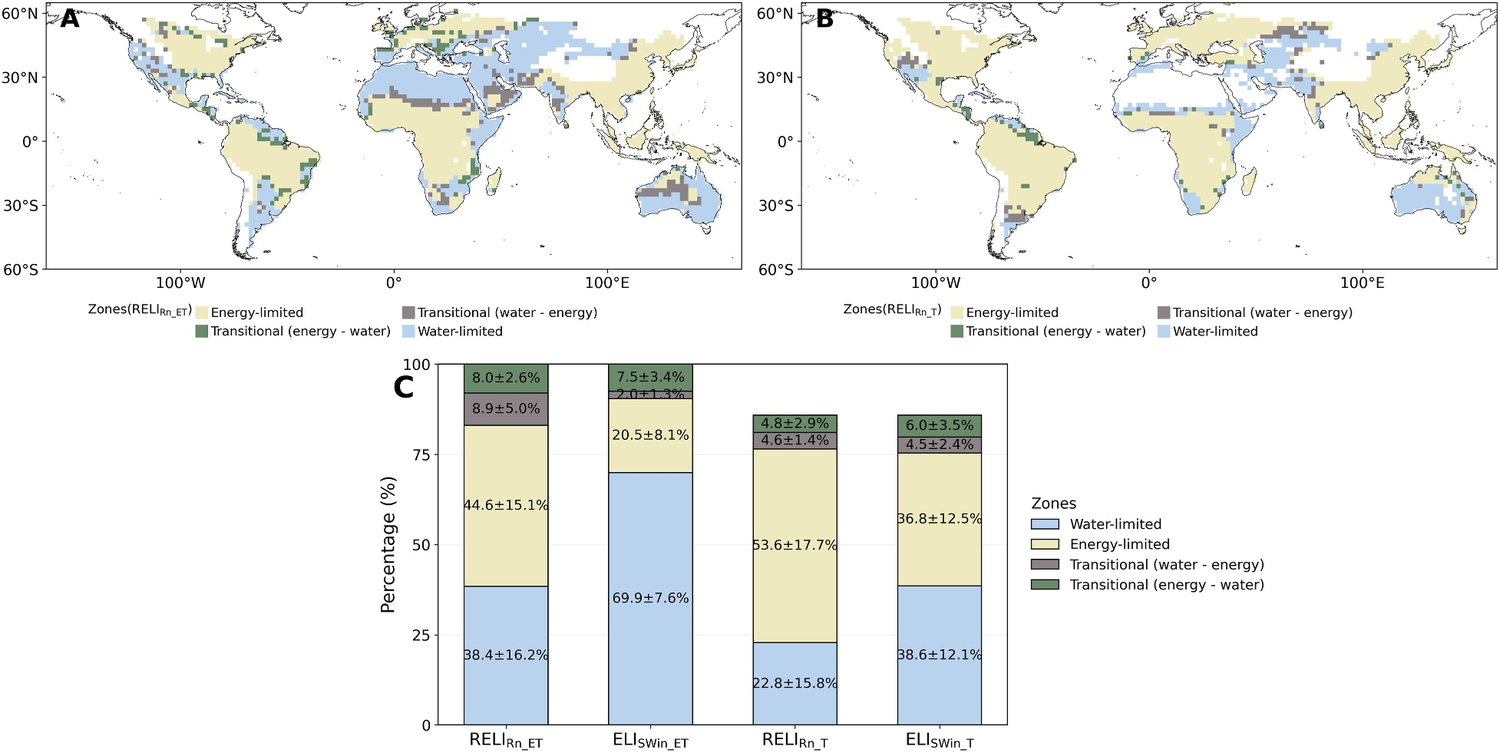
Classifying warm land by ensemble-mean RELI averaged over 1981–2010 and 2071–2100, about 38.4 ± 16.2% of the area (22.8 ± 15.8% for the T-based index) is water-limited in both periods, with most of the remainder energy-limited. Comparing the two periods reveals bidirectional transitions between water and energy limitation: roughly 8.9 ± 5% of warm land in semi-arid regions shifts from water to energy limitation, and about 8.0 ± 2.6% near humid margins shifts the other way. The two largely offset, so the global water-limited share shows only an insignificant net decrease (ET-based: −0.9 ± 5.5%) or a slight net increase (T-based: +0.2 ± 3.5%) (p > 0.05 for both). By contrast, the ELI computed with downwelling shortwave radiation alone yields 69.9 ± 7.6% water-limited area and a unidirectional net increase of +5.5 ± 4.2% (p < 0.05), with the excess concentrated in humid regions such as Amazonia, central Africa, northeastern North America, western Europe and Southeast Asia.
Mechanism: two CO₂ pathways cancelling out
Why is the net change so small? Look first at the magnitudes of the drivers: over 1981–2100 downwelling shortwave radiation increases by only 0.05 mm/d (water equivalent), whereas net radiation rises by 0.26 mm/d, with +0.15 mm/d from net longwave and +0.10 mm/d from net shortwave. In other words, the longwave radiation emitted downward by a warming atmosphere alters the surface energy budget more profoundly than changes in shortwave radiation do. Now the fluxes: evapotranspiration keeps rising while transpiration shows almost no trend, and the increase in evapotranspiration is driven mainly by enhanced non-transpirational physical evaporation, that is, canopy interception and soil evaporation; meanwhile, although leaf area index keeps increasing, the water-saving effect of leaf-scale stomatal closure largely offsets the extra water use implied by the expanding leaf area and rising VPD.
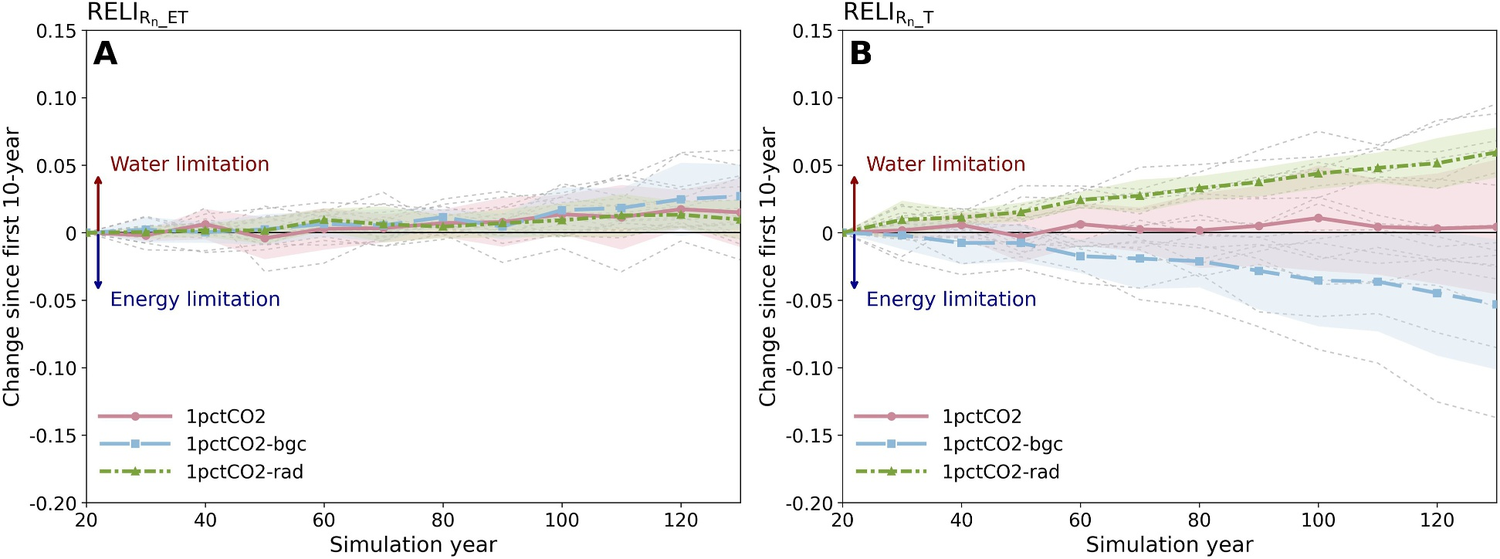
The idealized CO₂ experiments (six CMIP6 models with complete output, spanning 344.6–1135.2 ppm) separate the two pathways: radiative forcing alone significantly intensifies water limitation, with soil moisture increasingly constraining both ET and T; physiological forcing alone alleviates it, with the T-based RELI declining significantly as stomata close and water-use efficiency rises. Under full forcing the two nearly cancel, leaving net changes of +0.015 ± 0.0256 (ET) and 0.0044 ± 0.050 (T), neither of them significant.
Consistency with other diagnostics
The water-limited boundary delineated by a net-radiation-based aridity index with CO₂ correction (AIZhou_CO2; Zhou & Yu, 2024) agrees closely with RELI, particularly the T-based RELI, whereas the ELI computed with downwelling shortwave radiation identifies a markedly larger water-limited area, with the excess concentrated in humid regions. Substituting precipitation for soil moisture as the water-supply indicator brings RELI even closer to the aridity index — a reminder that transition zones are best diagnosed with both indicators in tandem: soil moisture captures the constraint of the root zone on vegetation, while precipitation captures canopy interception and rapid surface evaporation.

A methodology echoed by earlier work
The result echoes the group's earlier global drought study in Communications Earth & Environment. That work showed that Penman-type potential evapotranspiration amplifies drought trends because it does not fully account for land–atmosphere feedbacks, with energy-limited formulations yielding a global drying rate about 83% lower (−0.0014 versus −0.0084 yr⁻¹). The present study shows that an ELI built on shortwave radiation or air temperature overestimates water limitation through the same class of coupling. Both point to one methodological requirement: in aridity and limitation diagnostics, the energy term must be exogenous and must genuinely set the upper bound on the flux.
For ecosystem management, the expectation of universally intensifying water limitation needs revision: forest-density thresholds, the selection of drought-resilient species and the siting of restoration projects should rest on diagnoses of specific transition zones rather than on a uniform global trend. The authors are candid about the limits of the work. The analysis is diagnostic and inherits model representations of stomatal conductance, plant hydraulics and nutrient limitation; soil moisture is also an imperfect water-supply indicator for ET in places such as the Sahel, hence the precipitation-based complement.
Warming does not necessarily make ecosystems universally more water-limited; divergent conclusions often begin with the diagnostic itself.
The study, titled “No Net Increase in Ecosystem Water Limitation Under Greenhouse Warming,” was published online in Earth's Future on October 16, 2026. The first author is postdoctoral researcher Jiameng Xu of Tsinghua SIGS, and the corresponding author is Associate Professor Yuanchao Fan of Tsinghua SIGS. Co-authors include Associate Professor Kaighin A. McColl of Harvard University, Assistant Professor Alexis Berg of Université de Montréal, Yu Liang of the Institute of Applied Ecology, Chinese Academy of Sciences, and Associate Professor Jian Yang of the University of Kentucky.